
In this text, Terrestris co-founder Eric Kluitenberg reflects on a range of issues surrounding regenerative culture, art, and design, and their connection to the region (the Green Heart) we operate in.
Point of departure: regenerative culture?
Daniel Christian Wahl is a prominent advocate for regenerative design and regenerative culture. A few years ago, he posted an excerpt from his book “Designing Regenerative Cultures” (2016) on his blog with the daring title: “Sustainability is not enough: we need regenerative cultures.” This message raises all sorts of questions: After years of discussion about how to make production and consumption processes more sustainable (and all the obstacles to achieving this), is that suddenly no longer enough? How exactly should we understand his statement?

A regenerative human culture is healthy, resilient, and adaptable; it cares for the planet and it cares for life in the awareness that this is the most effective way to create a thriving future for all of humanity.”
(Daniel Christian Wahl)
In his public presentations, Wahl emphasises that he is not aiming to abandon the pursuit of “sustainability.” He sees it as a crucial step in finding answers to the challenges posed by rapidly deteriorating ecological conditions (a dramatic decline in biodiversity, global warming and climate change, and the depletion of natural resources). But it is not enough. According to Wahl, the attention of designers, and ultimately all of us, must focus on the underlying system that sustains and allows the health, resilience, and adaptability of life as a whole on our planet to flourish. A regenerative human culture is healthy, resilient, and adaptable. It cares for the planet and for life itself, recognising that this is the most effective way to create a flourishing future for all of humanity. (Wahl, 2017)
The core principle of a regenerative culture, and by extension, a regenerative design practice, revolves around the question which interventions can directly contribute to improving the ecological resilience, health, and diversity of the entire living system. Ecological regeneration aims not only to stabilise processes but to “design” them so that they contribute to a genuine improvement in the ecological conditions and integrity of a particular place or process. This is an inherently positive/generative approach (it generates possibilities and positive outcomes) and not a repetition of the well-known lamentations about ecological decline.
Terrestris, as a platform for art, design, and ecological regeneration, explicitly positions itself within and across the creative disciplines, art and design in the broadest sense: from landscape and garden architecture, land art, to object design, artistic research, architecture and urban planning, sound art and performance art, visual and auditory design, and much more. We question the (possible) relationships between these creative disciplines and the burgeoning regenerative cultures, as we see great potential in this for the region where we live (the Green Heart in the centre of the Randstad) and beyond.
The (Role of) Creative Disciplines
Within the creative disciplines, attention to ecological issues has increased significantly in recent years. This is primarily due to the increasingly pronounced effects of climate change and the climate and biodiversity crisis—or what philosopher Bruno Latour describes as the “New Climatic Regime.” Many public culture projects primarily focus on observation, analysis, critique, and aim to increase (public) awareness of the effects of these ecological processes by depicting them in an engaging way.
A good example of this is the recent large-scale exhibition Critical Zones – Observatories for Earthly Politics (ZKM Karlsruhe, 2020), curated by Bruno Latour and then-ZKM director Peter Weibel. This and similar projects (such as the Anthropocene Curriculum at Haus der Kulturen der Welt, Berlin) bring together a large number of inspiring projects, creators, initiatives, and works at the intersection of art, design, and ecology. The question, however, is how to make the leap from observation, reflection, and imagination to concrete interventions that contribute to the revitalisation and restoration of local and global ecosystems?
Latour’s concept of “Critical Zones” is important here: He emphasises that the “terrestrial” is not the globus—the Earth we observe from space. The perspective on the living planet, the “critical zone,” is the thin layer of only a few kilometres up and down in the air and soil: a vulnerable zone, the biosphere, within which all life unfolds.
A second Copernican revolution.
The first Copernican revolution demonstrated that it is the Earth that revolves around the Sun and not the other way around, thus giving humanity a new place in the universe: No longer at the centre, but at the periphery of a galaxy—visible as a faint glow in the background on clear nights, as the Milky Way. The second revolution, our current one according to Latour, no longer sees the Earth from this cosmic perspective, as a “blue marble” suspended in empty space. It is precisely necessary to “land” and literally adopt the most earthly perspective: the view onto the soil, the earth, the ground beneath our feet. The dream of escaping the planet offers no solution. Amusing in science fiction narratives and obscene in the fantasies of tech billionaires, but simply not an option for us (humanity), and even less so for all the more-than-human life that suffers horribly from this misplaced hubris.
In his Facing Gaia lectures, Latour succinctly summarised this point: “There is no escape from the condition of belonging to the world.” (Latour, 2013). Fictional travel through space may remain infectious entertainment, but after an evening immersed in that fantasy cosmos it is time to return to Earth, to land in the earthly, as Latour describes it.
At Terrestris, we want to explore how to take the next step. What direct contribution can the creative disciplines (design and the arts) make to improving the ecological conditions and the ecological integrity of a particular place or process (our working definition of regenerative culture)? First, by connecting the vibrant international discussion about regenerative design and regenerative arts and culture with the local perspective of the Green Heart region, its residents, and its visitors – our “landing zone.” And then, but only after that, beyond.
We ask ourselves: what should a design and artistic practice look like that itself pursues regenerative and ecologically positive goals?
In this regard, we collaborate closely with the inspiring Zoöp coalition, led by researcher and curator Klaas Kuitenbrouwer. Regenerative principles are central to the Zoöp concept, a new organisational structure that integrates the interests of all life forms (the Zoë) into its decision-making process.
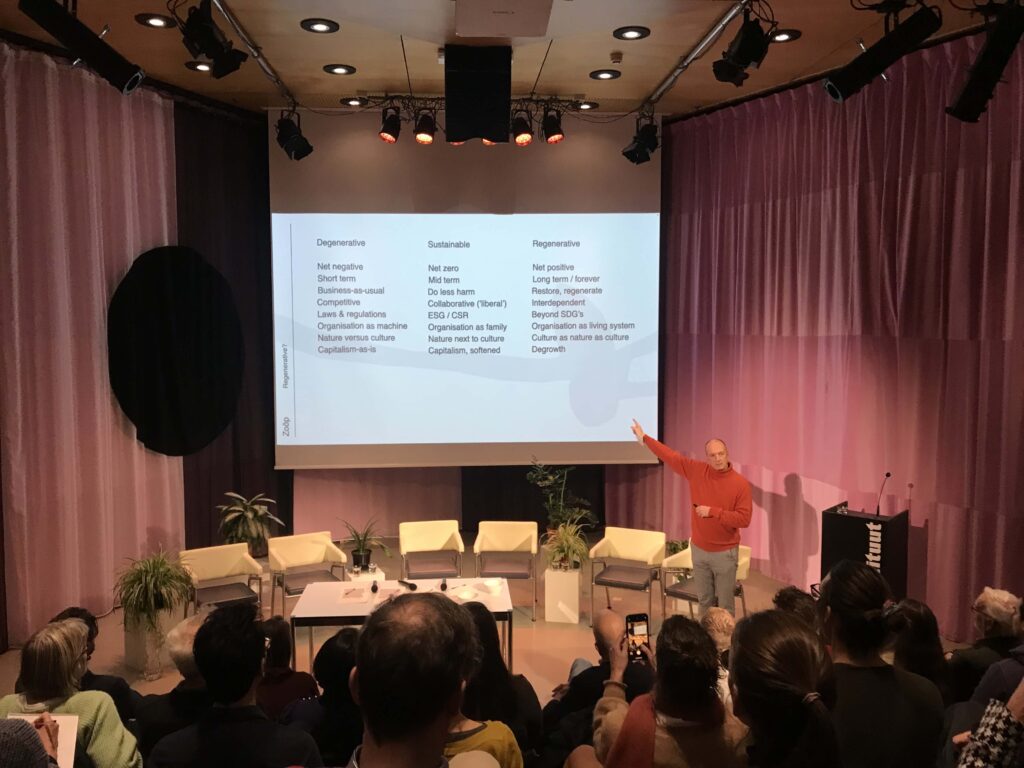
Regenerative principles go a significant step further than the usual discussions about sustainability, circularity, and cradle-to-cradle, which are well-known in the design disciplines and the arts. Kuitenbrouwer introduced the following overview at a Zoöp meeting on November 24, 2023, at Nieuwe Instituut Rotterdam to clarify this next step, from “business-as-usual” (Net negative), to sustainable (Net zero), and then on to regenerative (Net positive):
A lively international discussion has now emerged surrounding the new regenerative practices that pursue the transition from “net zero” to “net positive.” And this movement extends well beyond the creative disciplines. There is a rich practice surrounding regenerative agriculture, with numerous video channels, tutorials, and exchanges of knowledge and information. Within the design disciplines, there is a lively discussion about regenerative design. And while this concept may be less prominent in the arts, we at Terrestris see a great potential in the free perspective of artists to develop new scenarios for future transformations of landscapes, ecosystems, and the experience of the personal living environment. Actively involving local residents in the design process is crucial here.
How and where can we find a landing spot for Latour?
The gap between the abundance of data, knowledge, and alarming reports about ecological decline, declining biodiversity, and the climate crisis, and people’s personal experiences, who do not engage with these issues on a daily basis, is enormous. The creative disciplines can make a particularly significant contribution here by connecting the local living environment and personal experience with the strength and local applicability of ecological regenerative principles. Moreover, experience shows that it is embarrassingly easy to achieve ecological regeneration (on a small scale) simply by getting started (e.g., start flipping tiles!).
Latour emphasises, however, that all human capacities, knowledge, skills, practices, institutional arrangements, artistic imagination, context-sensitive design, technological, financial, and economic resources are needed to formulate an answer to the challenges posed by the new climatic regime to us humans and to all life on Earth. The question, of course, is: how do you achieve this? How can all these skills and capacities be deployed? And where?
The somewhat confusing answer to that question is: Everywhere! But speak to any permaculture specialist and they will explain that when you stick a spade in the ground, the soil you encounter will never be the same wherever you dig. The living system is infinitely complex and highly locally specific. Simple, as it were, “universal” solutions do not exist here.
Latour himself therefore calls for a new kind of cartography, a new map. One that collectively enables us to orient ourselves in this world that is so familiar and yet so alienated. But before we can draw a map, or rather an infinite series of maps, we must first find a place—a location where we find the ground beneath our feet, a landing spot as a point of orientation.
That landing spot is necessarily local, given the local specificity of ecological systems. And also knowledge of the local is largely found locally, among the people who live on and work with the land, the people who have taken this earthly perspective for granted, often for generations.
These local places are no longer isolated, if only because climate change is a global process. Knowledge, contact, and exchange are at the same time more vibrant than ever. Not least because of the dizzying growth of internet access, which now spans virtually the entire planet. However, this infrastructure itself also has its own (very) negative ecological effects, which is why the discussion about permaculture must also deepen to that of ‘permacomputing.’ The local here is not a reactionary or regressive form of closure, but rather one of connectedness in infinite diversity (for the sake of survival) and, of course, full of contradictions.
The Green Heart region – a sketch:
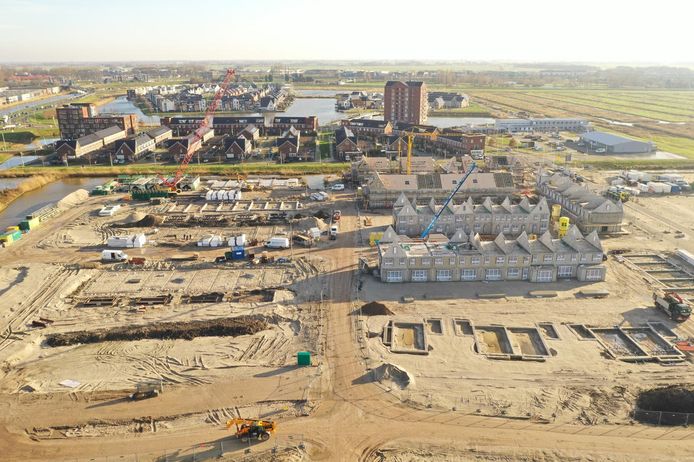
The Green Heart, our landing place, is a fascinating and diverse region where ecological issues, pressure on a historical cultural landscape, and new relationships between city and countryside converge in the so-called ‘Green Metropolis’ – a green ecological core surrounded by the urban agglomerations of the Randstad. This green core is under severe pressure due to increasing urbanisation (including the massive new Westergouwe district near Gouda), tension between recreational and natural functions, but also because traditional forms of agriculture and horticulture, which have characterised the region for centuries, are increasingly under ecological and economic pressure. The Green Heart offers an excellent context for putting regenerative culture into practice, for exploring more sustainable relationships between urban and rural contexts, and for developing new perspectives on and for the region.
The study “The Green Heart – Landscape Biography and Cultural-Historical Valuation” (2021) by the SteenhuisMeurs agency clearly describes how intensive land use has characterised the region for centuries. This was not limited to intensive agriculture. The draining of peatlands and peat production also played a significant role in shaping the landscape. Particularly in the north-west of the region, large areas of peat were reclaimed, processed into fuel (peat briquettes), and literally burned up. An ecological catastrophe in previous centuries that now results in a seemingly ‘idyllic’ recreational area of low-lying lakes and ponds.
Intensive agriculture has traditionally been practised in the polder areas (formerly also peatlands). However, draining this land not only leads to massive CO2 and nitrogen emissions, but also causes ongoing land subsidence in the area (due to the massive pumping of groundwater). This subsidence is 1 cm per year. Combined with the simultaneous rise in sea level, these agricultural practices are no longer sustainable after centuries. The region lies at the lowest point in the Netherlands, more than 6.5 meters below sea level. As a result, saltwater is constantly penetrating the region from the west, which will drastically alter vegetation, insect and bird populations, and ultimately the entire ecosystem in the coming decades.
Restoring wet peatlands that capture large amounts of CO2 and nitrogen is an obvious strategy to at least slow down these developments, to buy time. However, we also wonder what this development means for the self-image of the region and its residents, their personal and emotional ties to what defines their local living environment. How can we develop new scenarios in which residents themselves have a clear voice?
It is clear that “green” in the Green Heart does not equate to “nature.” We assume a human-inclusive ecology in which deeply rooted traditions of managing the land also play a significant role. At the same time, we notice that the voice of the “citizen” and “resident” is largely, if not entirely, absent from major research and policy programs.
New Bioregional Capacities
A key element of the lively discussion surrounding regenerative cultures is the concept of bioregions. These refer to regions defined by their specific ecological characteristics, not by political (national) boundaries. On land, researchers speak of an ecozone or “biome,” which designates a broad community of plants and animals, adapted to specific climatic conditions, found on different continents.
Bioregions are both locally specific and connected to zones elsewhere with similar climatic conditions. These bioregions often transcend national borders, but multiple bioregions frequently intersect a particular country or region. The concept of a bioregion primarily helps us better understand the specific characteristics of a given area, the typical life forms found there, natural vegetation and native animal species, as well as the forms of agriculture, planting, and cultivation that characterise the region.
Bioregions require a different map of the world. It resembles the new cartography Latour called for. The organisation One Earth has taken up this call quite literally and has made a “navigator” of Earth’s bioregions available on its website, clearly demonstrating this new classification.
Bioregions are not limited solely to natural systems. They also incorporate agricultural systems and characteristics into their model. This is a key difference from the highly globalised system of food production and distribution, which is driven by a multitude of economic, financial, and political considerations and often ignores the local/regional specificities of the living environment.
The result is a system, criticised by many, in which food and semi-finished products are transported around the planet primarily to serve “premium markets,” while the negative consequences of this system are often felt precisely where the majority of these products are grown. At the same time, local producers are experiencing increasing difficulty competing with this globalised system.
A key question raised by bioregions is whether this agroeconomic system can be better balanced by focusing more on (bio)regionally specific forms of production and consumption of daily food. It seems obvious that food production tailored to local bioregional specificities will ultimately lead to a more efficient food system and a reduced burden on the biosphere. However, this requires a better and deeper understanding of these regional and local specificities, which goes (substantially) beyond a classification into bioregional zones.
Bioregional Finance
A fascinating discussion that has recently developed focuses on how bioregionally specific forms of financing can be developed to support these bioregionally specific forms of agricultural production: ‘Bioregional Finance‘, or BioFi for short. Ultimately, the question is how to develop the organisational and material capacities that make such a reorientation towards the local bioregion possible and (also economically) feasible?
From the perspective of regenerative culture, the next question is how such bioregionally specific systems can be designed so that they actively contribute to strengthening local ecological conditions and the ecological integrity of the region. It should also be noted that bioregional zoning is not static. Due to climate change the boundaries of climatic conditions are shifting, (new / different) forms of vegetation, geography (accumulating versus evaporating water, erosion, etc.), and changing populations of microscopic and macroscopic life forms are manifesting. The effects of climate change never move neatly in one direction…
The discussion thus shifts to the organisational capacities needed to put ecological regeneration into practice at different scales. This requires much more than (a series of) administrative or policy interventions. It requires a new perspective, a different way of looking at the living environment, the place of humans within it, and our interconnectedness with the multiformity of other life forms.
According to various critics, a simple adjustment to the orientation of the financial and economic system is far from sufficient, even though it can generate (limited) positive effects. Recently, Commons specialists David Bollier and Natasha Hulst proposed an alternative approach to financial systems they call “relationalized finance.” They believe that such forms of financing are designed to support and deepen new relationships – social, economic, and political – regulated by the population among themselves (the commons). Humane and designed to support the generative capacities of living systems. Whereby ‘nature’ (ecology) and financing are no longer considered separate, but rather intimately intertwined.
This requires a fundamental shift in perspective, both practically / pragmatically, ethically, and culturally / symbolically. This shift in perspective precedes any ‘designed’ concrete intervention. But shifts in perspective are precisely the ideal and natural domain of the arts. As a colleague once aptly put it: “While all the monkeys are trying to conquer the highest position in the tree, the artist is the monkey that shouts: ‘Hey! We’re in the wrong tree!'” It is then the designers who can translate such new insights into context-sensitive interventions. And it is this dual function that Terrestris is looking for.
Eric Kluitenberg
February 2026
Addendum
The table below combines the cited overview by Klaas Kuitenbrouwer on regenerative culture with that of Kunttu, Henttonen, et. all (2025) about circular and regenerative economy:

References:
Daniel Christian Wahl, Designing Regenerative Cultures, Triarchy Press, 2016.
Bruno Latour, Down to Earth, Polity Press, 2018.
Iivari Kunttu, Kaisa Henttonen, Leena Kunttu, Jari Jussila, Anne-Mari Järvenpää1, Nina Helander: Regenerative Practices in Circular Economy SMEs, Journal of Circular Economy (2025) 3:3, 342-357 – https://doi.org/10.55845/QOPR9934